B2B Direct Mail · 5 Min. Read
Endless Fold vs Accordion Fold: Which Format Belongs in Your B2B Direct Mail?
Both fold. Both give you more panels than a postcard. But an endless fold and an accordion fold create fundamentally different experiences in the recipient’s hands — and that difference determines which format belongs in your next B2B campaign.
The Core Difference
A standard accordion fold has a clear start panel and a clear end panel. It unfolds in alternating directions across four or more panels — like the musical instrument it’s named after — and reads sequentially from left to right. The recipient opens it once, moves through the panels, reaches the end. It’s a well-established B2B direct mail format suited to brochures, product overviews, and multi-step campaign pieces where the goal is information delivery.
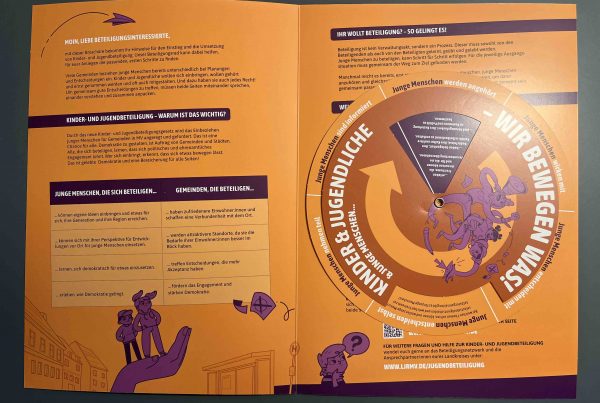
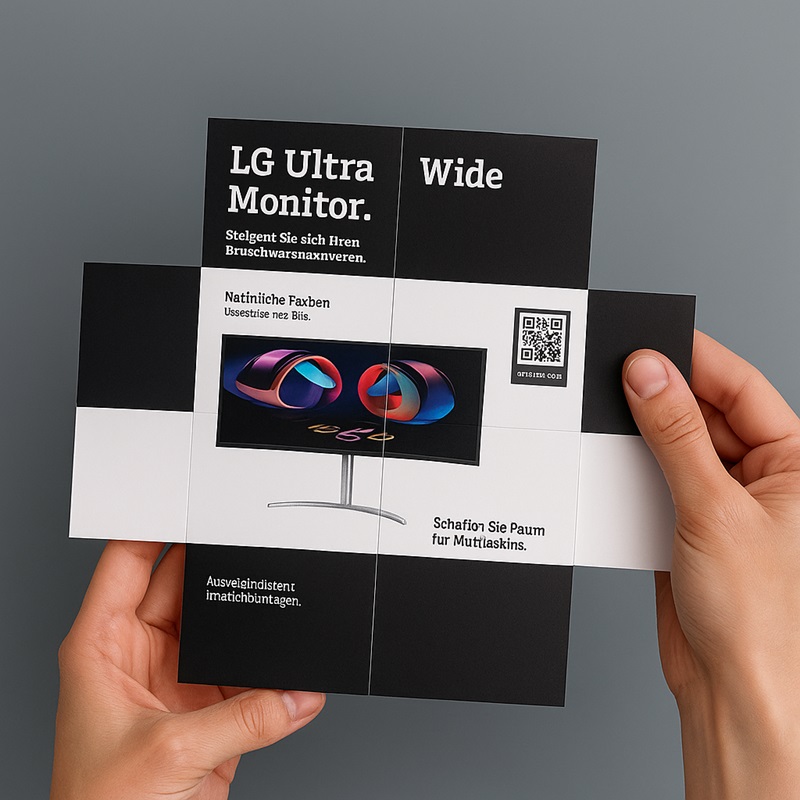
An endless fold is engineered differently. The folds connect back on themselves so there is no definitive start and no definitive end. Fold it one direction, then reverse, then forward — and it keeps going. The recipient cannot finish the piece in a single pass because there is no natural stopping point. Every fold opens to a new face. This is not a longer accordion fold — it requires a specific die-cut and fold construction that creates the continuous loop. The physical consequence is measurable: recipients handle the piece multiple times, show it to colleagues, and keep it on the desk because the mechanism itself compels re-engagement.
The simplest frame: the accordion fold is read. The endless fold is explored.
When to Use Which Format
Choose an accordion fold mailer when your message is sequential and content-heavy. A product launch with four distinct features. A service overview that walks the buyer through a process. A brochure that needs to carry detailed information across multiple panels in a readable order. The accordion works because it behaves like a document: organized, linear, easy to scan. It also works well as a USPS self-mailer — sealed with a tab, it mails flat without an envelope at standard letter rates.
Choose an endless folding card when the experience matters as much as the content — when you want the recipient to interact with the piece more than once, pass it around an office, or keep it on a desk simply because it’s compelling to hold. The endless fold is not a longer brochure. It is a physical brand moment that communicates creativity, quality, and investment before a single word is read. It requires an envelope for mailing, which adds a small cost — but that envelope also adds an element of anticipation that a self-mailer cannot replicate.
One decision test: if you would be satisfied sending the content as a PDF, the accordion fold is sufficient. If the format itself needs to carry part of the message — if the piece needs to feel different from everything else in the recipient’s mailbox — use the endless fold.
B2B Direct Mail Use Cases
In B2B campaigns targeting senior decision-makers, dwell time is the metric that matters most after delivery. A postcard gets a glance. A letter gets read once. An accordion fold mailer gets read through. An endless fold card gets handled repeatedly — and shown to others. That multiplication of impressions from a single mailed piece is what separates the formats at the account-level.
Accordion fold use cases: Trade show pre-mailers with a clear message sequence. Product comparison pieces for evaluation-stage buyers. Multi-step campaign inserts where information density matters more than interaction time.
Endless fold use cases: High-value cold outreach to a precisely targeted account list where the piece itself signals investment. Product launch announcements where the format amplifies the news. Trade show leave-behinds that stay on the desk long after the show floor closes. VIP invitations where the physical quality of the piece communicates the level of the event.
Both formats are available with premium finishes — soft-touch lamination, hot foil stamping, spot UV — making them suitable for the same premium positioning tier. More on B2B trade show promotional materials and dimensional direct mail formats that work across the full campaign cycle.
Production & Minimum Order
Both formats are available from 50 units. Production lead time: 12–14 business days from print approval. Endless fold cards require an envelope for mailing. Accordion fold mailers can be sent as USPS self-mailers without an envelope.
Making the Right Call
Three questions settle it. First: is the format part of the message, or is the content the message? If the content carries the weight — accordion. If the format itself needs to communicate quality and differentiation before it’s opened — endless fold.
Second: does the piece need to work as a self-mailer? Accordion fold mailers seal with a tab and mail flat at USPS letter rates. Endless fold cards require an envelope — but that envelope adds anticipation and positions the mailing closer to a premium gift than a promotional piece.
Third: how many times do you want the recipient to handle the piece? Once is enough for a product brochure. Multiple times is required for brand imprinting. The endless fold’s mechanism ensures that no single pass feels complete — which is why recipients keep going.
For most B2B campaigns where the goal is account-level brand differentiation and decision-maker recall, the endless fold outperforms the accordion on the metrics that drive pipeline: dwell time, pass-along, and the likelihood the piece is still visible on the recipient’s desk when a buying decision is made.
Accordion fold or endless fold — the choice is not about which looks better. It is about what happens in the recipient’s hands after the piece arrives. One delivers a message. The other creates an experience. In B2B direct mail targeting senior buyers, the experience usually wins.
Frequently Asked Questions
What is the difference between an endless fold and an accordion fold?
An accordion fold has a clear start and end — it unfolds sequentially and reads like a document. An endless fold connects back on itself with no definitive start or end: the recipient keeps folding in either direction without a natural stopping point. The accordion delivers content; the endless fold creates an experience.
Which format is better for B2B direct mail?
Depends on the objective. For information delivery — product overviews, service explanations — the accordion fold is efficient and cost-effective. For brand differentiation and maximum dwell time with senior decision-makers, the endless fold outperforms on dwell time, pass-along rate, and unaided recall.
Can endless fold cards be mailed without an envelope?
No — endless fold cards require an envelope due to their continuous fold structure. Standard accordion fold mailers can be sealed with a tab and mailed as USPS self-mailers without an envelope at standard letter rates.
What is the minimum order quantity?
From 50 units for both formats.
How long does production take?
12–14 business days from print approval.