Image Change Cards · 5 Min. Read
Slat Card Direct Mail: The Image-Change Format That Demands a Second Look
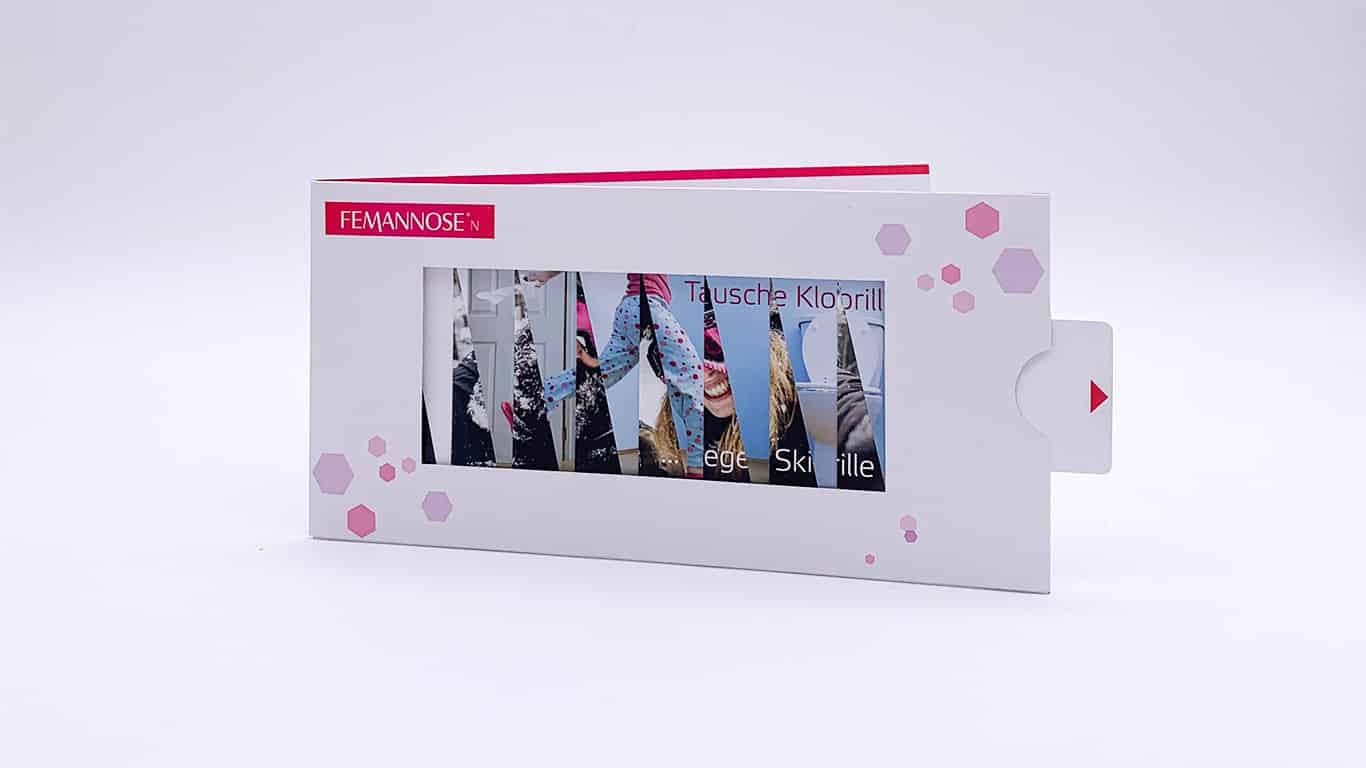
A slat card shows two different images in one piece — pull the tab, and the picture changes instantly. It sounds simple. The effect on the recipient is not.
What Is a Slat Card?
A slat card is a printed piece with parallel slats on the surface. Alternating slats show Image A; the ones between them show Image B. Depending on the viewing angle or a pull-tab mechanism, the visible image switches — from picture A to picture B, from message one to message two, from before to after. The effect is purely mechanical: no power, no app, no plastic lens.
That last point separates the slat card from a lenticular postcard, which uses a plastic lens that shifts the image as the viewing angle changes — the effect happens passively, to the viewer. A slat card requires a deliberate hand action: the recipient pulls the tab. That small difference has a large consequence for retention. When someone physically triggers the reveal, they participate in the message rather than merely receiving it. The act of engagement creates stronger memory encoding than passive observation — which is precisely why slat card direct mail outperforms standard postcards for brand recall.
What the Pull-Tab Image Change Does for Your Campaign
The most common application is the before/after reveal: Image A shows the starting state, Image B shows the outcome. For any product or service that delivers a visible transformation — a property before and after renovation, a dashboard before and after implementation, a brand identity before and after redesign — this is a format that communicates the transformation in the recipient’s hands rather than on a screen.
Beyond before/after, the image-change mechanism works as a pure attention device: two product angles, two campaign visuals, two versions of a message. The slat card holds the recipient longer than any standard mailer because pulling the tab once is never enough — the physical curiosity of the mechanism triggers repeated engagement. Each time, the brand is present.
A third application is the thematic contrast: problem on one side, solution on the other. Or two product variants. Or a pre-event invitation that transforms into a post-event thank-you — all in a single piece that surprises on first contact and re-engages on every subsequent pull.
Slat Cards as B2B Direct Mail
As a dimensional direct mail format, slat cards work across three core B2B scenarios. As a cold outreach mailer, they stand out in any mailroom — standard DL format, flat enough to mail, but with a mechanism that demands attention the moment the envelope is opened. As a trade show pre-mailer, sent to a targeted list before the show, they drive booth traffic by giving prospects a physical reason to seek out the sender. And as a leave-behind after a sales conversation, they stay on the desk and continue telling the brand story with every subsequent pull — a post-meeting touchpoint no email follow-up can replicate.
The critical advantage over standard B2B print formats is active participation. Unlike email, direct mail puts your message directly on paper, in the hands of your buyer — and a slat card goes further, putting the message *in motion* in those hands. The recipient doesn’t just read it. They operate it.
Production & Minimum Order
Slat cards are available from 100 units. Production lead time: 12–14 business days from print approval. Direct mailing to your contact list available.
Industries and Occasions
Slat card direct mail is used across industries wherever a before/after, a product comparison, or a dual-message format creates stronger impact than a single static visual. In real estate and architecture, for renovation reveals or new development comparisons. In software and SaaS, for dashboard or UI before/after campaigns targeting enterprise decision-makers. In pharma and MedTech, for treatment outcome visualizations or device comparisons. In automotive, for model-change or feature-upgrade campaigns. And in brand and agency work, for before/after rebrand presentations that arrive as a physical piece rather than a PDF attachment.
What all of these use cases share: the recipient must pull the tab to see both messages. That single act of physical participation separates the slat card fundamentally from passive print formats — and is the reason it gets kept, passed on, and remembered when standard mailers don’t.
More on formats, variants, and technical options on the image change cards product page.
A slat card isn’t a novelty. It’s a precision communication tool that fits two messages into one format and requires the recipient to engage. For B2B marketers who want a direct mail piece that gets handled rather than recycled — this is the format that delivers.
Frequently Asked Questions
What is a slat card?
A printed card with parallel slats on the surface. Depending on the viewing angle or a pull-tab mechanism, it switches between two distinct images or messages. The effect is purely mechanical — no lens, no electronics, no app.
How is a slat card different from a lenticular postcard?
Lenticular postcards use a plastic lens that shifts the image as the viewing angle changes — the effect happens passively. A slat card uses a pull-tab mechanism on paper stock: the recipient pulls the tab, triggering the reveal. The physical action creates stronger memory encoding than a passive tilt.
What is slat card direct mail used for?
Product launches, trade show pre-mailers, before/after campaigns, product comparisons, and high-value B2B prospect outreach — wherever two messages or images need to land in a single direct mail piece.
What is the minimum order quantity?
From 100 units.
How long does production take?
12–14 business days from print approval.