What Are Endless Fold Cards — And Why Are B2B Brands Using Them in Direct Mail?
If you’ve never heard of an endless fold card, you’re not alone. It’s one of the best-kept secrets in B2B direct mail — a format that’s been quietly delivering results for pharmaceutical companies, automotive brands, and financial services firms in Europe for years, and is now gaining traction with US marketing teams.
This article explains what endless fold cards are, how they work, and why they outperform standard direct mail in campaigns where attention is everything.
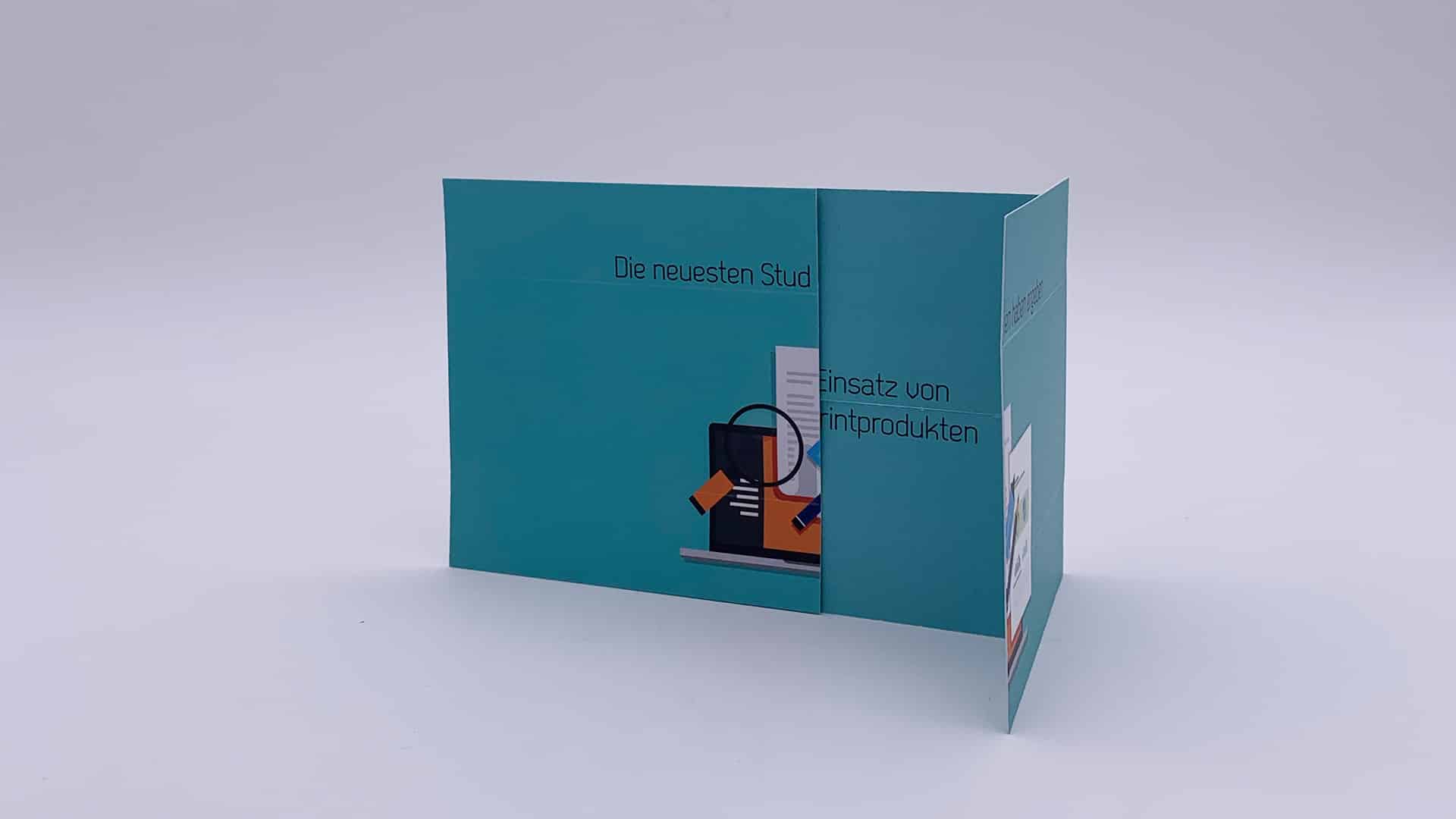
What Is an Endless Fold Card?
An endless fold card is a printed marketing piece built on a unique folding mechanism. What looks like a standard two-sided card unfolds into four fully printable panels — and can be folded and refolded continuously without a fixed beginning or end.
Every time the recipient picks it up, they fold it again. Every fold reveals a new panel, a new image, a new message.
No electronics. No QR code. No app. The entire effect is mechanical — engineered into the paper itself.
The format goes by several names in the market:
- Endless fold card
- Infinity fold card
- Infinite fold card
- Continuous fold card
All refer to the same product. The mechanics are the same. The effect is the same.
How Does an Endless Fold Card Work?
The folding mechanism is the key. Unlike a standard brochure — which has a fixed front, back, and interior — an endless fold card has no fixed orientation. The four panels are arranged in a continuous loop.
Here’s what happens when a recipient receives one:
- They open the envelope and see what appears to be a simple printed card
- They fold it open — and a second panel appears
- They fold again — a third panel
- They fold again — a fourth panel
- They fold again — and they’re back to the beginning
The loop is seamless. Recipients instinctively keep folding, driven by the same curiosity that makes people flip through a well-designed book. That tactile engagement is the format’s core strength.
Why Endless Fold Cards Work in B2B Direct Mail?
Standard direct mail has a problem: most of it gets thrown away.
Research consistently shows that up to 90% of standard mail pieces never make it past the initial sort. They get opened, glanced at, and discarded — or never opened at all.
Endless fold cards behave differently, for three reasons:
1. The tactile engagement loop The folding mechanism triggers an instinctive physical response. Once a recipient starts folding, they don’t stop at one fold. The piece demands interaction — and interaction means time spent with your message and brand.
2. The pass-around effect Endless fold cards get shown to colleagues. The novelty of the format — something that folds continuously without a clear end — is a natural conversation starter. The piece travels through an organization on its own. Standard print doesn’t do that.
3. The desk retention effect Because the format is inherently interactive and visually interesting, recipients keep endless fold cards on their desks long after the initial mailing. That translates into sustained brand visibility that no digital ad can replicate.
What Can You Put on an Endless Fold Card??
Four panels means four distinct content opportunities. How brands use them varies by campaign objective:
Sequential storytelling Panel 1: Problem. Panel 2: Solution. Panel 3: Proof. Panel 4: Call to action. The format is naturally suited to narrative — each fold advances the story.
Product portfolio showcase Each panel features a different product, variant, or use case. Ideal for product launches and line extensions in CPG, automotive, and tech.
Event invitation with layered information Panel 1: Save the date. Panel 2: Event details. Panel 3: Speaker or agenda highlights. Panel 4: RSVP or registration. Used extensively for trade show invitations, symposia, and corporate events.
Brand story For anniversary campaigns, new brand launches, or investor communications — the four-panel format gives brands room to tell a story that a single-sided mailer can’t contain.
Field sales leave-behind A compact, interactive piece that a sales rep leaves after a meeting. The recipient picks it up again later, re-engages with the content, and remembers the conversation.
Use Cases by Industry
Pharma & Life Sciences Physician mailings, congress invitations, and study summaries for field reps. A piece that a physician folds and refolds while reading is a piece that gets read — in full.
Automotive New model teasers, dealer network communications, and launch event invitations. The sequential panel structure is ideal for revealing a vehicle story in stages.
Financial Services Investor event invitations, new product introductions, and premium client communications. The format signals premium positioning before the recipient reads a word.
Technology Product release announcements, partner communications, and trade show materials. Complex messaging benefits from the four-panel structure — one key point per panel.
CPG & Consumer Goods Trade marketing campaigns and retail partner communications. Can be combined with product samples or promotional inserts while still mailing flat.
Agencies New business pitches and capability presentations. If you’re selling creative thinking, the mailer needs to prove it.
Endless Fold Cards vs. Standard Direct Mail: A Direct Comparison
Standard Flat Mailer
Endless Fold Card
Opens on first contact
Time spent with content
Pass-around effect
Desk retention
Panels available
Reuse / re-engagement
Format Options
Endless fold cards are available in a range of formats and can be fully customized:
Standard formats:
- Slim fold format — approx. 4″ × 8″ (comparable to a standard #10 mailer)
- Square format — approx. 6″ × 6″
Custom options:
- Logo-shaped die-cuts
- Circular formats
- Any custom dimension
Surface finishing: Matte lamination, soft-touch lamination, gloss, UV spot coating, foil stamping, embossing, debossing — all surfaces inside and out.
Minimum order quantity: 200 units. For specific requirements, contact us for a custom proposal.
How Endless Fold Cards Fit Into a Multi-Touch Campaign
Endless fold cards work best as part of a campaign sequence — not in isolation. Here’s how B2B brands combine them with other dimensional formats:
Pre-show → At show → Post-show An endless fold card as a pre-show invitation creates anticipation. A pop-up cube mailer at the booth drives engagement. A slat card as a post-show follow-up keeps the brand visible after the floor closes.
Prospect outreach sequence First touch: endless fold card introducing the brand. Second touch: video brochure with a product demo. Third touch: personalized follow-up with a sales insert. Each format escalates the engagement level and investment signal.
The Bottom Line
Endless fold cards are not a novelty. They are a proven direct mail format that outperforms standard print on every metric that matters — open rate, time-on-content, pass-around effect, and desk retention.
For B2B brands and agencies working in high-value markets where the cost of a missed impression is high, the format delivers a return that standard mail simply can’t match.
Frequently asked questions
Are endless fold cards expensive?
Relative to standard flat mail, yes — but the comparison isn’t fair. The relevant comparison is cost-per-engagement, not cost-per-piece. A standard mailer that gets discarded has a high cost-per-engagement. An endless fold card that stays on a desk for weeks and gets shown to three colleagues has a very low one.
Can the content be updated after production?
No — unlike video brochures, endless fold cards are purely print. All content is fixed at production. Plan your content carefully before going to press.