B2B Print Marketing · 7 Min. Read
Corporate Pop-Up Book: How B2B Brands Use 3D Print to Make an Impression
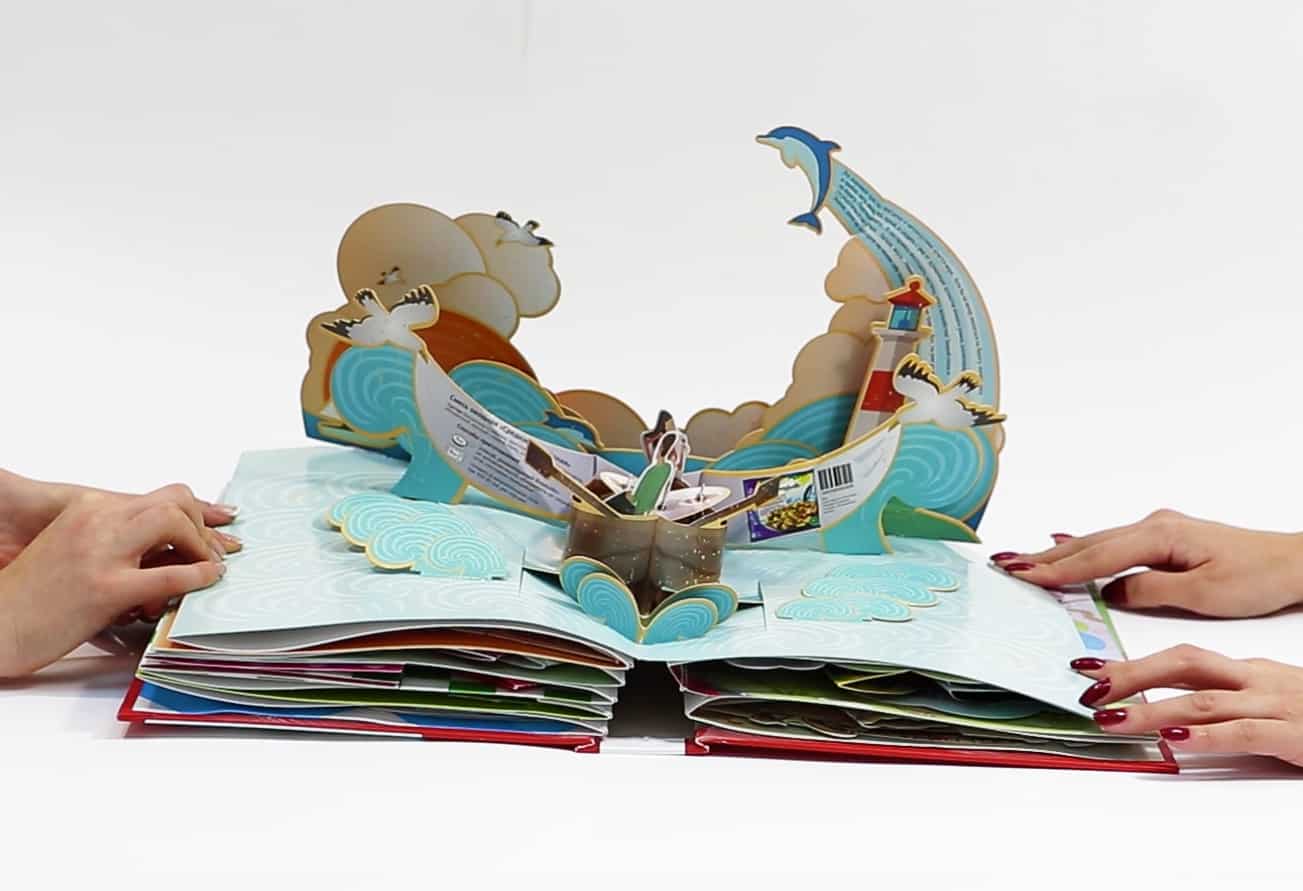
A corporate pop-up book is not a children’s book — it’s a presentation format that uses three-dimensional paper engineering to make products, brands, and stories physically tangible. In B2B marketing, it’s deployed wherever a standard brochure falls short and digital formats leave no lasting impression.
What Is a Corporate Pop-Up Book?
A corporate pop-up book is a custom-produced print piece in which pages unfold into three-dimensional structures when opened — buildings, products, processes, logos, or abstract forms that spring directly from the page. The mechanism is based on precisely cut and folded paper constructions that work without electronics, batteries, or apps. The result is a tactile experience that draws the recipient immediately into the content.
Unlike a corporate video or a digital presentation, a pop-up book stays physically in the hands of the recipient. It gets opened, leafed through, passed around. It ends up on desks, in meeting rooms, in archives — and remains present long after the meeting is over.
When Does a Corporate Pop-Up Book Make Sense?
This format isn’t for every campaign — it’s a premium instrument for situations where the first impression is decisive and a standard mailing won’t cut through. Three scenarios have proven particularly effective in practice.
The first is high-value first contact. When a company reaches out to a major prospect, investor, or strategic partner, a custom-produced pop-up book signals intent before a single word is read. It communicates quality, creativity, and seriousness in a way that an email or PDF deck simply cannot. The second scenario is a product launch. New products that are complex to explain or have a strong visual dimension benefit enormously from the three-dimensional format. A new vehicle model, a medical device, an architectural project, or a complex service portfolio — all can be staged spatially in a pop-up book in a way that flat print can’t replicate. The third scenario is a company anniversary or brand story. When a brand reaches a milestone, a pop-up book is the format that combines gravitas with impact. The company’s history becomes a journey, each spread a chapter.
Industries & Use Cases
A corporate pop-up book is not a niche product — it’s used across industries wherever presentation and differentiation are decisive.
In pharma and MedTech, pop-up books are produced for sales force materials, conference invitations, and the visualization of complex mechanisms of action. A drug shown three-dimensionally inside the body stays in memory differently than a standard brochure. In automotive, pop-up books have long been a proven format for vehicle reveals, dealer communications, and investor mailings — the spatial presentation of a vehicle works better in three dimensions than on a flat page. For architecture and real estate, the pop-up book is a natural presentation format: buildings and developments can be shown three-dimensionally before a single foundation is laid. In financial services and insurance, they are used for investor relations and premium client communications. Technology companies use pop-up books for product launches, partner conferences, and pitch materials — particularly when the product itself is abstract or complex to explain. For agencies, a pop-up book is a new business pitch that proves creative thinking before the meeting even starts.
Production & Minimum Order
Corporate pop-up books are available from 50 units. Production lead time is 12–14 business days from print approval. For complex mechanisms with multiple pop-up levels, plan additional time for engineering and sample approval.
Design & Mechanisms
A corporate pop-up book is crafted with precision — and that craft is exactly what gives it its value. Every spread is engineered by a paper engineer: the three-dimensional structures must snap into position exactly when the page is opened, and fold flat cleanly when closed. This requires mathematical precision in construction, skilled hands in execution, and close collaboration between designer and paper engineer.
Content-wise, the format is flexible. Individual spreads can show products in three dimensions, build processes step by step, stage brand elements spatially, or simply accent text and illustration with pop-up elements. The entire book surface — pages, cover, spine — is fully printable and can be combined with all standard finishing options: soft-touch lamination, hot foil stamping, spot UV, embossing. Formats range from a compact 5×5 inch book to large-format presentation volumes.
Production Process
Producing a corporate pop-up book is more complex than most other print products — and that’s exactly why it requires experienced hands. The process starts with a detailed briefing: target audience, occasion, content, number of spreads, desired mechanisms, and budget. From there, a paper engineer develops the construction plans for each pop-up spread. Physical samples are built and approved before full production begins. Assembly is done by hand — every pop-up book is hand-built, folded, and glued.
This makes the format more costly than standard print, but also incomparable in its impact. When someone opens a custom-produced pop-up book, they experience something no digital medium can replicate. More on formats, mechanisms, and reference projects on our corporate pop-up books page or in our full range of dimensional direct mail formats.
A corporate pop-up book is the format for moments when a lasting impression is non-negotiable. It costs more than a brochure, takes longer than a flyer, and outperforms both. In a market where everyone has a deck, a three-dimensional book is the signal that actually lands.
Frequently Asked Questions
What is a corporate pop-up book?
A corporate pop-up book is a custom-produced print piece in which pages unfold into three-dimensional structures when opened. Used by B2B brands for product launches, company anniversaries, investor presentations, and high-value prospect outreach — anywhere a lasting physical impression matters.
What is the minimum order quantity for corporate pop-up books?
Corporate pop-up books are available from 50 units. For smaller quantities on highly exclusive projects, contact us directly.
How long does production take?
Production lead time is 12–14 business days from print approval. Including concept development, paper engineering, and sample approval, plan for 6–8 weeks from briefing to delivery.
What occasions are corporate pop-up books used for?
Product launches, company anniversaries, investor relations, high-value prospect outreach, conference invitations, and annual reports — anywhere a standard format doesn’t do justice to the message.
Can corporate pop-up books be mailed?
Yes. Pop-up books ship flat and can be mailed directly to your contact list. Addressing, fulfillment, and mailing services are available as a complete package.
What mechanisms and finishing options are available?
From simple 90° pop-ups to complex multi-level constructions with moving elements, fold-out spreads, and rotating discs. Finishing options include soft-touch lamination, hot foil stamping, spot UV, and embossing — all panels inside and outside. A paper engineer guides development from sketch to physical sample.